

Written by: Azmath Pasha, Chief Digital Officer, and Kireet Kokala, Cloud Delivery Leader
Click here for the complete white paper: Enabling Digital Intelligence Though ThoughtSpot
ThoughtSpot, a modern cloud analytics company makes it easy for business teams to ask questions while providing power and flexibility for data experts. While ThoughtSpot’s platform has been around for almost a decade, it has recently enjoyed a larger audience thanks in part to data intelligence solutions that are being pushed by Snowflake Data Cloud, AWS, Azure, Google Cloud Platform, and several others.
A strategic solution partner of ThoughtSpot, Paradigm Technology’s Digital Intelligence capability presents an accelerated path from data to decisions. Below, we provide tactical overviews of several of our proprietary ThoughtSpot-driven data architectures and explore digital intelligence propelled by the user-first technology that’s driving organizations to achieve insights in real-time.
Exploring a Reference Architecture for ThoughtSpot on Cloud
The market offers strong tools like Tableau, Qlik, and Power BI offering extensive capabilities for analysts and developers. However, we see a self-service gap inherent in data consumption ecosystems, solved by ThoughtSpot. ThoughtSpot was designed on the idea that business users should be able to query and create visualizations for their data without needing an understanding of programming languages.
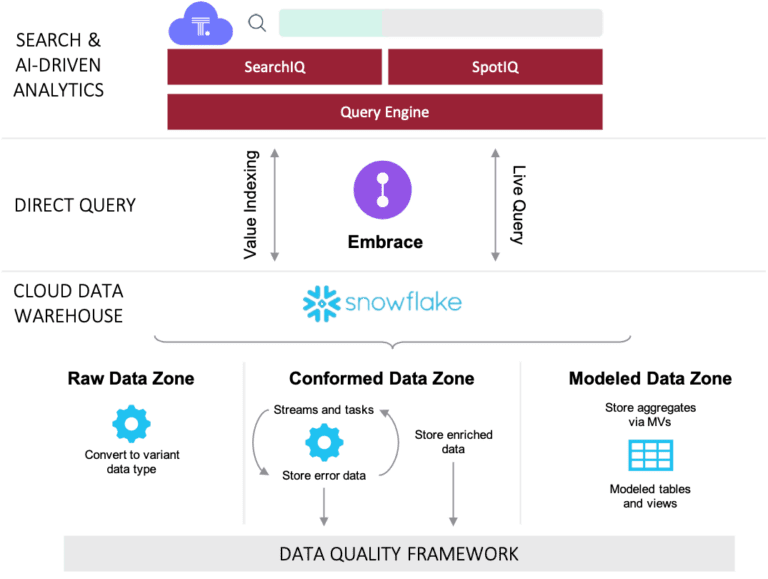
Reference architecture for a ThoughtSpot Pinboard. SpotIQ was used to detect anomolies; Paradigm modeled and enriched the underlying Snowflake data from a Raw Data Zone to a Modeled Data Zone for efficiency.
Paradigm tested our comprehensive cloud reference architecture coupled with Snowflake, using medium and large datasets that were simulated from performance limitations experienced with other traditional BI platforms. After data was pulled from Snowflake, we used ThoughtSpot’s Query Engine to pull quality data and enable instant insights with no hiccups in performance. While running an advanced data search, ThoughtSpot’s technology auto-generated a visual that best matched the underlying data, with enhanced capability to change or update as desired.
The visual was easily relatable and tieable to the shared open board “Pinboard”, ThoughtSpot’s version of a dashboard. Default plots and visuals were enhanced in a few clicks.
Business users in mind, we ran successful simulations exploring additional use case-based data to generate insights with Natural Language Querying (NLQ). ThoughtSpot’s AI feature, SpotIQ, enabled us to generate and drive useful insights that we wouldn’t have thought of from traditional rendering. We added new data, introduced anomalies, and changed our test scales. Speed and scalability were consistent in all our tests. Ultimately, ThoughtSpot was asking questions of our data that business SMEs hadn’t considered!
ThoughtSpot Cloud Accelerates Digital Intelligence
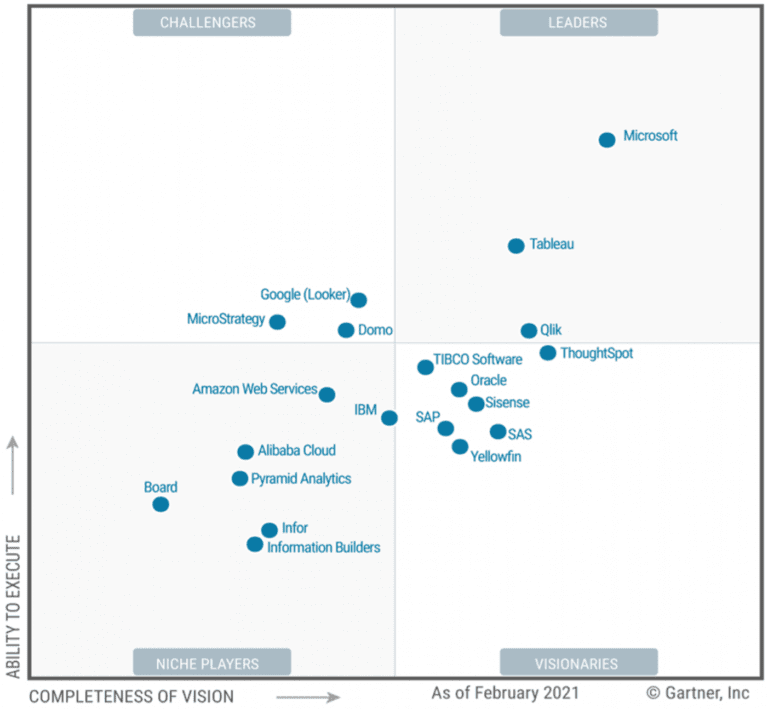
Gartner (February 2021) Magic Quadrant for Analytics and Business Intelligence Platforms
According to Gartner’s Magic Quadrant, ThoughtSpot is a steady Visionary and soon-to-be Leader promising to be a ubiquitous, intelligent data platform as data storage and its enabling architecture continue to evolve. Through ThoughtSpot’s partnership with leading data cloud platform Snowflake, Paradigm anticipates differentiated capabilities such as ThoughtSpot Cloud, ThoughtSpot One, and ThoughtSpot Embrace will catapult them into the Leaders quadrant.
Data intelligence growth propelled by ThoughtSpot is inevitable. Experts in this space have witnessed the evolution of data storage and advanced analytics from enterprise data warehousing to lake houses. Coupled with a shift in data ownership being decentralized in a global data mesh.
Enabling technology for decentralized data ownership are data pipelines that were built to support and elevate domain data as a primary driver for business, enabling cross-functional domain-oriented teams to consume data faster.
Through digital intelligence, consumption needs have grown – mechanisms that empower a wider ecosystem of data products and architecture patterns are changing. Propelled by a strong shift in priorities from traditional data warehousing to cloud data estate modernization, tier-1 global enterprises are struggling to tackle pre-existing performance and modeling shortcomings (technical debt). At the same time, huge demand and skyrocketing need for services like streaming, text, and machine learning have created new capability areas like Cloud Lakehouse, which combines cost and flexibility advantages of a data lake with ease of data warehousing management. Data surrounding DataOps and continuous integration/continuous delivery (CI/CD) pipeline mechanisms are evolving to support these new approaches.
ThoughtSpot’s robust cloud capabilities are razor-focused – built with business users in mind to unify data consumption from hyperscalers such as AWS, Azure, Google Cloud Platform, and Snowflake, driving sources into a single pane of management. In essence, efficiently integrating, harmonizing, and leveraging data mesh globally.
Key success criteria for organizations leveraging ThoughtSpot is a highly decentralized data architecture aimed at treating data as a product, driving insights, and enabling digital intelligence quicker in the hands of business users.
As ThoughtSpot brings order to cloud data warehouse, lake, and mesh architectures, Paradigm’s strategic partnerships with ThoughtSpot and Snowflake better position our customers’ digital intelligence needs with next-gen technology. We address cloud-based offerings with data ownership and organizational scaling to reduce or eliminate architecture and user adoption issues for data warehouses, lakes, and mesh.
Digital Intelligence Put to Action
Paradigm’s focus in Advanced Analytics enables digital intelligence through self-service analytics, AI/ML, enhanced search, and indexing capabilities. Let’s look at how digital intelligence through ThoughtSpot eliminated a lengthy backlog in reporting for one of our customers.
Client Challenge
Paradigm’s client, a niche retail banking company, struggled to empower their business users with accessible data for team decision-making and collaboration. They were unable to drill into existing reports for insights, and limited resources on their BI team led to long backlogs for new reports.
Solution Benefits
Paradigm implemented a Snowflake-powered data warehouse, AWS S3 data lake, as well as ThoughtSpot for analytics and business self-service. While ThoughtSpot’s technology stack addressed the groundwork, Paradigm’s digital intelligence experts simplified and automated our client’s analytics pipeline as illustrated below.
- Eliminated reporting backlog queue of 2 years
- Instant self-service analytics
- Easily define, discover, measure, quantify, and collaborate on all data
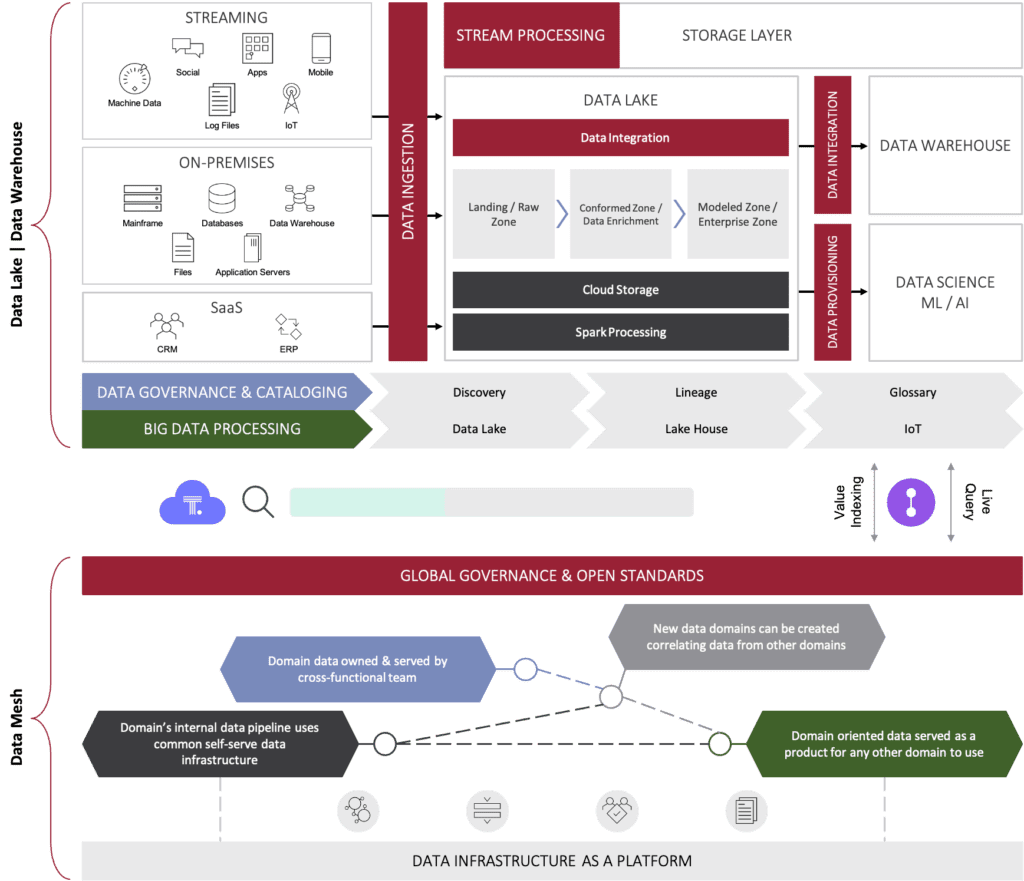
Paradigm’s ThoughtSpot analytics pipeline reference architecture
This implementation’s core effort was orchestrated within the data storage layer (see illustration), resulting in ease of management, time savings, and a single version of the truth for the business. Further project delivery confirmed a 2-year reduction in time to data insights and an emergence of a data mesh was active where ThoughtSpot Pinboards and insights were increasingly being accepted by business users. Infusing digital intelligence at every level of their data estate solution architecture was critical to accelerate and showcase quick “wins”, democratizing data enterprise-wide while bringing their business users closer to data insights.
Key Takeaways with Digital Intelligence
The on-premise and cloud data landscapes continue to evolve at breakneck speed. Among data intelligence solutions to pick from, ThoughtSpot has emerged with a uniform platform that’s business first, built with self-service in mind. Whether underlying data is a mix of flat files, data warehouse, lake, or mesh, the technology provides a single pane of management with AI-driven analytics.
Together, Paradigm Technology and ThoughtSpot give you the edge in accelerating digital intelligence from your data estate. Whether navigating a complex data landscape or modernizing your data footprint, we will help your business grow faster, stay protected, and spark advanced analytics innovation – that’s the Power of Paradigm.
Click here for the complete white paper: Enabling Digital Intelligence Though ThoughtSpot